

Ferrero H39 – from bunkers to skyscrapers

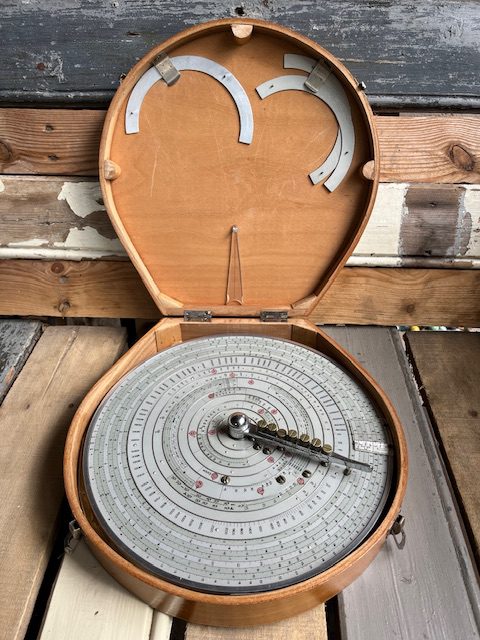
This beautiful circular slide rule is as good as they ever were. It functions like a slide rule but is built like a machine. And quite a machine it is! Ten concentric aluminium rings, a sophisticated mechanical operating system and a manufacturing quality that makes you wonder whether the Ferrero brothers were building a calculator or something considerably more ambitious.
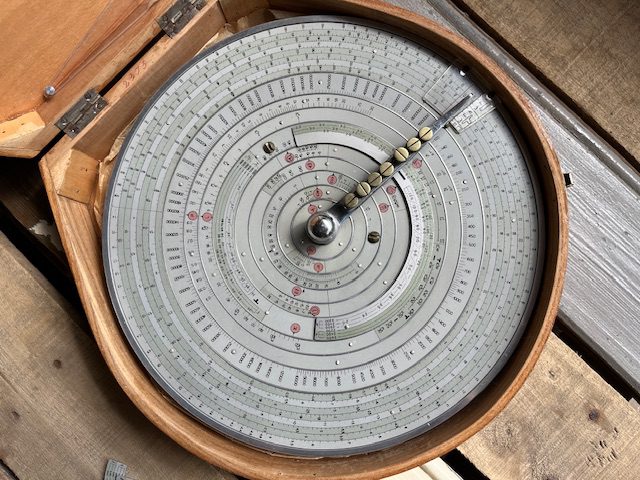
The Ferrero H39 was developed for calculating reinforced concrete structures. Not your everyday multiplication and division, but the complicated engineering involved in determining the dimensions and reinforcement of beams, pillars and other constructions. In fact, this was much closer to an early analogue computer than an ordinary slide rule. And it was already available in the late 1930s.
When your boss gets a Ferrari 166 Inter, you get a Ferrero H39
Imagine being a thirty-year-old structural engineer in Italy, somewhere around 1950. You work for a successful engineering company that has been involved in major construction projects before and during the war. Business is changing, but there is certainly no shortage of work. Entire cities need rebuilding, housing is desperately needed and reinforced concrete is becoming increasingly important.
Your boss has just bought himself a beautiful Ferrari 166 Inter. You, on the other hand, have your eyes on another magnificent piece of Italian engineering: the Ferrero H39.
While other manufacturers were trying to make slide rules affordable for everyone, the Ferrero brothers were building a machine that only a handful of people actually needed. Fortunately, those were people who could convince their employers to pay for it.
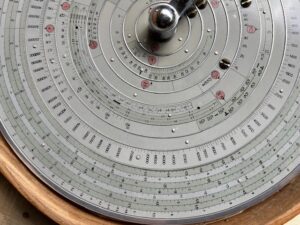

And why wouldn’t they? An instrument that could save considerable calculation time and help reduce the quantities of concrete and steel required for a construction project could easily justify a substantial investment. Especially when the alternative was paying an engineer to work through complicated formulas all day.
When the sky was the limit
The development of the H39 coincided with a remarkable period in construction history. During the 1930s and the Second World War, enormous amounts of reinforced concrete were used for bridges, industrial buildings, military fortifications and some rather ambitious German building projects. Hitler certainly had a thing for concrete, although some of his other interests were considerably less constructive.
After the war, reinforced concrete became essential to the reconstruction of Europe. The emphasis shifted from military fortifications to housing, infrastructure and increasingly ambitious buildings. From bunkers to apartment blocks and eventually skyscrapers, structural engineers faced complicated calculations involving loads, dimensions, material strengths and reinforcement.
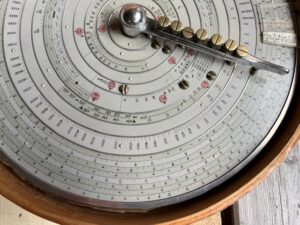
Washington Sabatini, an Italian civil engineer, had already recognised this problem during the 1920s. He developed a series of specialised calculating machines, initially manufacturing them himself. His Washington calculators evolved through several generations before the Ferrero brothers of Savona acquired his patents and developed the compact H39, introduced around 1937.
Sabatini’s earlier inventions had already been patented in several European countries and the United States. The H39 continued that development, bringing numerous structural calculations together in one impressive mechanical instrument. Instead of performing each operation separately on a conventional slide rule, an engineer could enter the relevant parameters and read the result directly.
For those interested in the original mathematics, the Italian Washington Ferrero H39 instruction manual is available online. Personally, I find the machine itself considerably more interesting than the calculations.
La meccanica fantastica
Italy has a wonderful history of combining engineering with beautiful design, and the Ferrero H39 certainly belongs in that tradition. Much like the contemporary Ferrari 166 Inter, its appeal goes well beyond what it was originally intended to do.
While conventional slide rules were still being produced largely from wood and celluloid, the Ferrero brothers created a substantial precision instrument with ten concentric aluminium rings, nine of them movable. The rings can be individually engaged through an ingenious system of spring-loaded buttons on the operating handle. Additional aluminium scale arcs can be fitted to expand the instrument’s calculating possibilities.
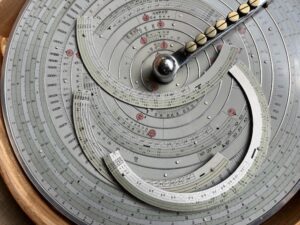
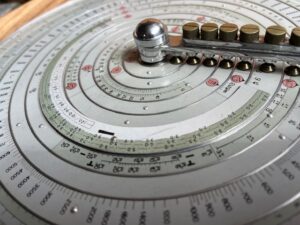
For comparison, have a look at this Graphoplex Babcock & Wilcox circular combustion calculator from 1952. Another sophisticated specialised calculating instrument, but manufactured entirely from plastic, more than a decade after the Ferrero H39 was introduced.
Both instruments demonstrate how far manufacturers were prepared to go when developing specialised calculating tools. But the mechanical construction and finish of the Ferrero are on another level. If the Ferrari was built for driving pleasure, the Ferrero was built for calculating pleasure. At least for the sort of engineer who enjoyed calculating reinforced concrete.
The calculator nobody could calculate with
What happened to these expensive professional instruments when electronic calculators took over? Unlike ordinary slide rules, the H39 was of little practical use to anyone unfamiliar with its very specific application. Perhaps some remained in engineering offices for decades, while others went home with retiring engineers or were sold when companies closed.
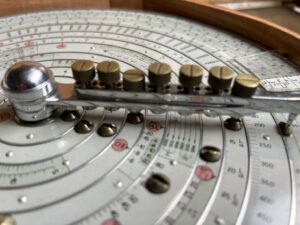
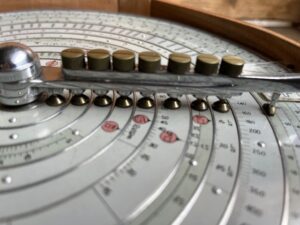
Imagine inheriting a wooden case containing a complicated metal instrument with ten rotating rings, mysterious scales and several loose aluminium parts. You probably wouldn’t have the slightest idea what it was, let alone how to operate it. Fortunately, it looks expensive enough not to throw away.
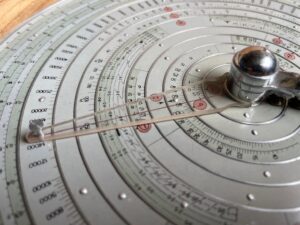
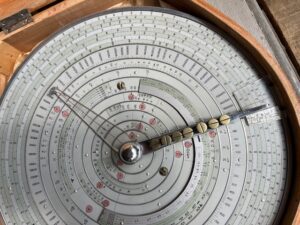
And perhaps that explains how some of these machines survived in such remarkable condition.
Number 2374 – the complete package
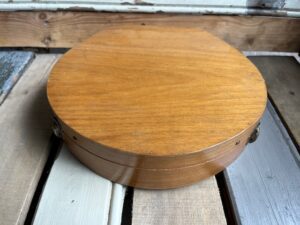
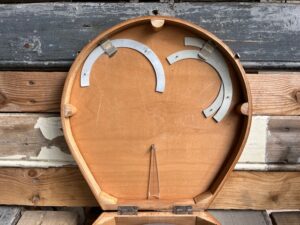
The Ferrero H39 shown here carries the individual number 2374 and is in excellent condition. It comes in its original plywood carrying case, accompanied by three additional aluminium scale arcs and a separate transparent arrow-shaped cursor. As far as I have been able to establish, all the original accessories are present, particularly when compared with the handful of other examples documented online.
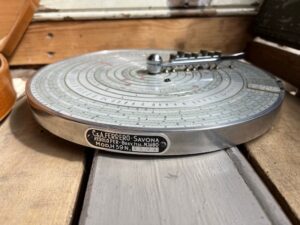
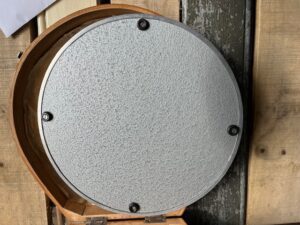
The Rechnerlexikon illustrates the development of the earlier Washington machines and shows a set of three additional H39 scales. Another H39, with the consecutive number 2375, is documented on Photocalcul. The higher serial numbers and differences in carrying cases suggest that production continued beyond the initial introduction, possibly into the 1950s.
Nathan Zeldes also owns an H39, housed in a different type of carrying case and accompanied by two additional aluminium arcs. He has written an excellent article titled Sabatini’s magnificent calculator, including a fully illustrated step-by-step explanation in English of how the machine actually works. Anyone interested in operating one should definitely have a look.
Within the world of specialised concrete slide rules, the Ferrero H39 occupies a fascinating position. It shows what could happen when the familiar principles of a slide rule were developed into a purpose-built mechanical computer, with little apparent concern for keeping things simple or inexpensive.
Almost ninety years after its introduction, it remains an impressive example of Italian engineering. And unlike a Ferrari 166 Inter, you can still admire every mechanical detail without leaving your desk.
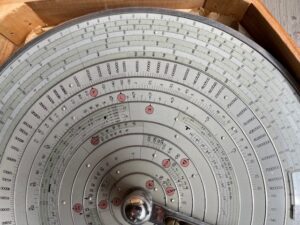
Interested in purchasing this Ferrero H39? Feel free to contact me.